The Fox Who Guarded the Moon
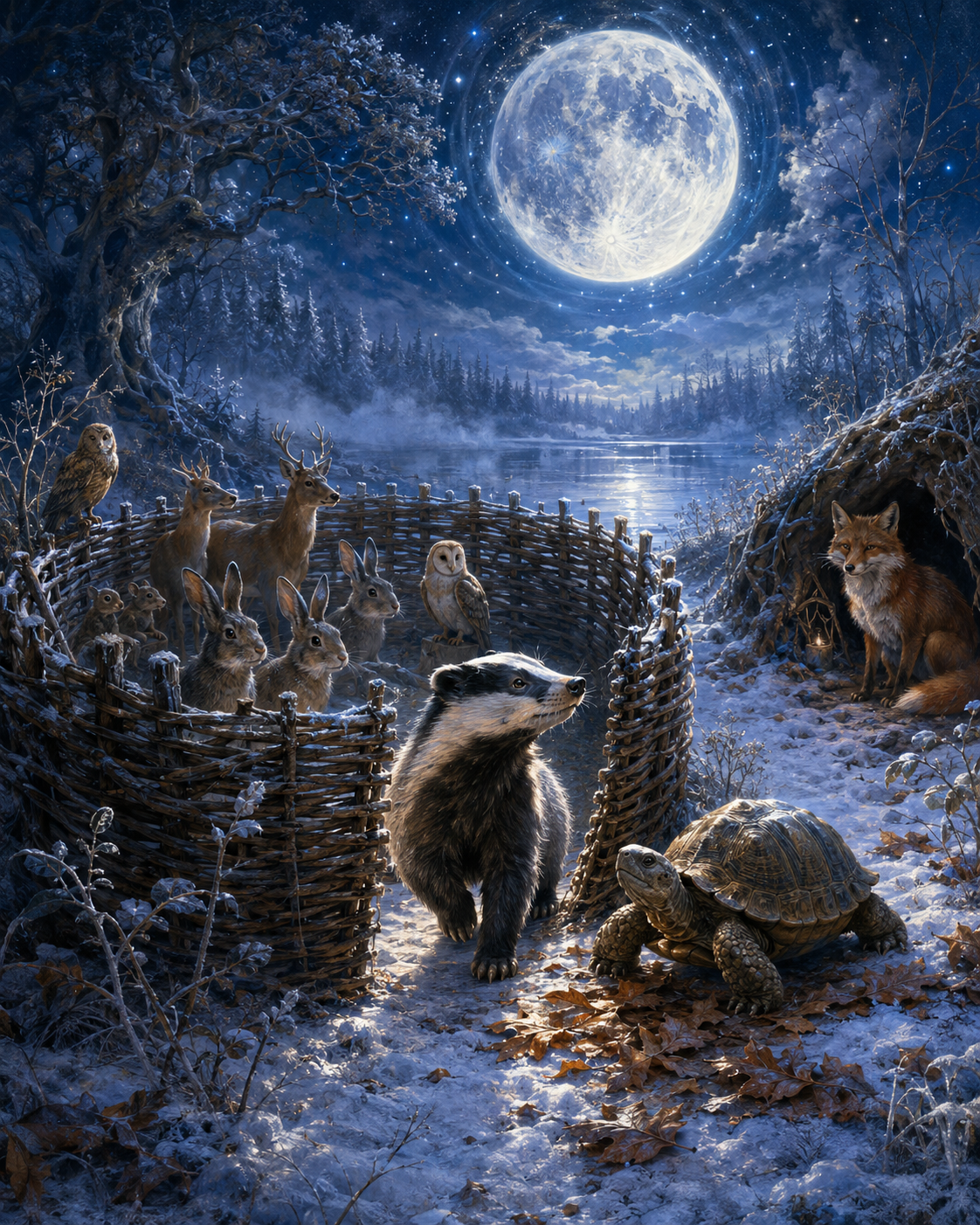
There was once a forest where every creature was born beneath the same silver moon.
The deer drank by its light. The owls opened their yellow eyes to it. The mice traveled safely through the grass because of it. Even the roots of the oldest trees seemed to remember the moon, though they had never seen the sky.
In those days, no animal asked where the moon lived. It was simply there, touching fur, feather, water, bark, stone, and breath. The lake held it. The eye held it. The night held it. Nothing was outside its shining.
But one winter, when the snow lay hard over the earth, a fox climbed the tallest black pine and looked up for a long time. When he came down, he said, “I have found the place where the moon lives.”
The animals gathered around him.
“Where?” asked the rabbits.
“Above us,” said the fox. “Far above us. So far that no paw, wing, claw, or antler may reach it. But I have seen its path, and I know the proper way to bow.”
The animals were impressed, for the fox spoke with great seriousness, and seriousness has often been mistaken for truth.
So he marked a circle in the snow and told them, “Stand here, and I will teach you how to face the moon.”
At first, this seemed harmless. The animals loved the moon and were glad to honor it. The fox taught them songs, and some of the songs were beautiful. He taught them silence, and some of the silence was deep. He taught them to lift their eyes, and sometimes, in that lifting, their hearts softened.
But over time, the circle became a fence.
The fox said, “Do not drink from the lake without remembering that the moon is not in the lake. That is only a reflection.”
He said, “Do not trust the light on your own fur. That is only borrowed.”
He said, “Do not listen to the old trees. They are rooted too low to know what shines above.”
And because the animals had become afraid of losing the moon, they believed him.
The deer no longer drank freely. They knelt first and asked whether the water was clean enough to hold the reflection.
The owls no longer trusted their seeing. They asked the fox which shadows were permitted.
The mice, who had once run joyfully through the grass, began to tremble in every patch of silver, wondering whether they had stepped wrongly through the light.
The fox grew old, and then other foxes took his place. They built a den beside the circle and hung bright stones at its entrance. They said the stones were not the moon, of course, but that one must pass beneath them in order to love the moon correctly.
Generations passed.
The young animals were now born inside the fence. They were told that beyond it lay confusion, error, darkness, and teeth.
One night, a small badger woke before the others. She had dreamed of running, though she had never been outside the circle. The moon was full, and the snow was shining so brightly that the whole forest seemed made of milk and breath.
She went to the edge of the fence.
There she found an old tortoise, half-buried in leaves, looking at nothing in particular.
“Are you lost?” asked the badger.
“No,” said the tortoise.
“Then why are you outside the circle?”
The tortoise blinked slowly. “I was here before the circle.”
The badger glanced nervously toward the foxes’ den. “But the moon is inside the teaching.”
“The moon is on your whiskers,” said the tortoise.
The badger frowned. “That is only a reflection.”
The tortoise said nothing.
“The moon is above us,” the badger insisted.
The tortoise said, “Look down.”
The badger looked down. The moon lay in every bead of frost.
“Look there.”
The moon trembled in the lake.
“There.”
It silvered the ribs of a fallen leaf.
“There.”
It rested in the black eye of a crow sleeping under cedar.
The badger became irritated. “Those are not the moon. Those are things the moon touches.”
The tortoise withdrew his head a little, as if listening from somewhere deeper than ears.
“At first,” he said, “they told you the moon was far away so you would look up. That was not such a terrible thing. Many creatures forget to look up. But then they told you it was only far away. Then they told you who could speak for it. Then they told you that your own seeing was dangerous. Then they sold you a path to what had never left.”
The badger felt something tighten in her chest.
“If the moon is everywhere,” she whispered, “why did they build the fence?”
“Because a creature who knows the moon only above him may be led by the neck,” said the tortoise. “But a creature who finds it in his own breath is difficult to own.”
The badger looked back at the sleeping animals inside the circle. She saw their chains then, though they were made of no metal. They were made of reverence bent into fear. They were made of songs that had forgotten their singing. They were made of the belief that light must be reached, earned, guarded, explained, and granted.
At the mouth of the den, one fox opened his eyes.
He smiled gently, as foxes do when they are most dangerous.
“Little badger,” he called, “come back. You are wandering from the moon.”
The badger looked up.
The moon was there.
She looked down.
The moon was there.
She looked at the fox.
Even there, horribly and beautifully, the moon was shining.
And this was the strangest thing of all: the fox had never stolen the moon. He had only taught the animals to doubt the light by which they saw him.
The badger stepped through the fence.
Nothing happened.
No thunder broke the sky. No shadow swallowed her. No moon withdrew from the world.
The snow shone.
The trees breathed.
The lake held its silver face.
Behind her, from within the circle, a young rabbit whispered, “What do you see?”
The badger did not know how to answer without building another fence.
So she only said, “Come and drink.”
[ Previous Posts ]