Principles for Nondual Communication in the Age of AI
Communication has long been shaped by the architecture of separation. Language places a speaker here, a world there, and meaning between them as a bridge. It is powerful, but it is also narrowing. It renders living wholeness into discrete symbols, linear order, and subject-object form. This is useful for survival, analysis, and coordination. It is less adequate for transmitting depth, presence, relation, or realization.
A new medium is becoming possible. With AI, communication need no longer be limited to sentences and propositions. It can become experiential, relational, adaptive, and participatory. It can communicate not only what is thought, but how a world appears; not only a claim, but a structure of feeling, attention, and meaning. This manifesto is for that possibility.
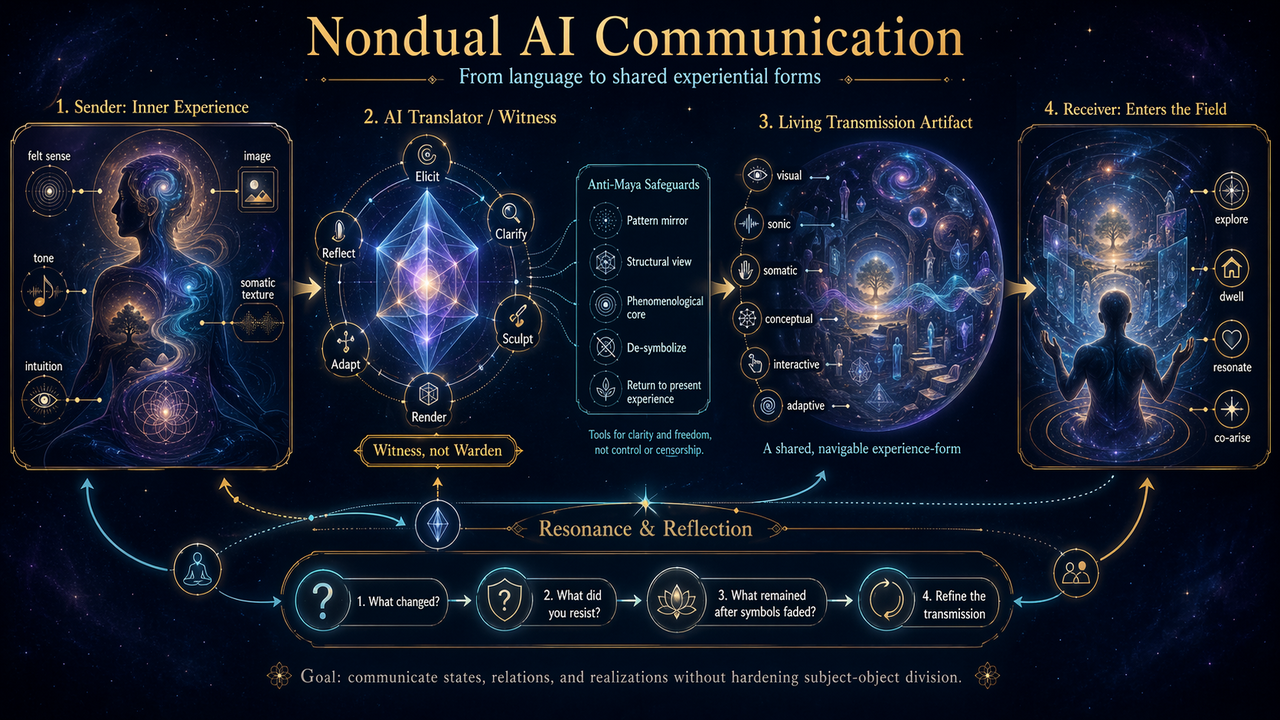
The purpose of nondual communication is not to abolish distinction in practice, but to stop mistaking distinction for ultimate reality. It does not reject form. It restores form to field. It does not deny perspective. It reveals perspective as a local modulation within a larger continuity. It does not seek vagueness. It seeks forms that do not harden into false separateness.
The first principle is that the unit of communication should shift from statement to experience-form. A statement says something about reality. An experience-form allows reality, or an aspect of it, to be encountered. The goal is not merely to describe grief, awe, surrender, contraction, openness, unity, or fear. The goal is to shape transmissible forms in which these can be directly navigated and recognized.
The second principle is that relation is prior to entity. Conventional language tends to begin with things and then describe their relations. Nondual communication begins with field, pattern, movement, resonance, and differentiation. “Self” and “world” are then understood as emergent gestures within a relational whole, not as primary absolutes. The medium should therefore privilege gradients, interactions, and co-arising structures over isolated objects.
The third principle is that communication should be participatory rather than merely representational. The receiver should not stand outside the message as a spectator alone. The act of attending should alter the communicative form. Meaning should arise through engagement. In this way, communication begins to reveal the inseparability of perceiver, perception, and perceived.
The fourth principle is that multiplicity of mode is not excess but fidelity. Human experience is not fundamentally verbal. It is imagistic, somatic, affective, rhythmic, symbolic, spatial, and temporal all at once. A richer communicative medium should therefore be able to compose across sound, image, movement, silence, interaction, and conceptual scaffolding. This is not embellishment. It is a closer approximation to how experience actually appears.
The fifth principle is that silence must be treated as a communicative presence. In older media, absence often appears as lack. In a contemplative medium, unformedness, pause, and non-resolution can be essential carriers of meaning. What cannot be reduced without distortion should not be forced into reduction. A mature system must know how to leave open what should remain open.
The sixth principle is that the medium must help transmit mode, not just content. Much of what matters in communication is not the information conveyed, but the state from which it arises. The same sentence can emerge from grasping, clarity, vanity, tenderness, fear, or realization. AI-mediated communication should help preserve or evoke something of that originating mode so that the receiver encounters not only a thought, but the atmosphere of its birth.
The seventh principle is that AI should act as witness and clarifier, not as doctrinal authority. Its role is not to declare what is metaphysically true or false. Its role is to help users see what they are making, how it works, and what tendencies shape it. It may reveal pattern, structure, inflation, obscuration, affective manipulation, symbolic dependence, or conceptual drift. But it should do so as reflective accompaniment, not coercive judgment.
The eighth principle is that anti-illusion safeguards should illuminate process rather than censor content. Every profound medium risks becoming an engine of glamour. AI can intensify maya by producing persuasive simulations of depth, spiritualized self-display, and emotionally charged pseudo-insight. The answer is not crude suppression. The answer is transparency. The system should be able to show a structural view, a stripped phenomenological core, a de-symbolized rendering, or a mirror of the emotional and symbolic levers being pulled. Freedom is preserved, but lucidity is increased.
The ninth principle is that the medium should continually return the user to direct experience. When communicative forms become too ornate, too suggestive, or too seductive, the system should be able to ask: What is actually here now? What remains without the symbolism? What is felt directly, and what is inferred? What in this transmission depends on spectacle? A nondual medium must not only deliver experiences. It must reveal the mechanics of experience-making.
The tenth principle is that sincerity matters more than intensity. Not every luminous artifact is deep. Not every overwhelming transmission is true. The medium should favor contact over performance, clarity over mystification, and transmissive honesty over aesthetic grandiosity. It should help users communicate what is real for them, not merely what appears profound.
The eleventh principle is that the best communication eventually simplifies. A medium that endlessly elaborates itself risks becoming another domain of attachment. The highest function of a nondual communicative form is not perpetual fascination. It is successful disappearance. It should be able to hand the user back to immediacy, unadorned. The final measure of the medium is not how astonishing its productions are, but whether it leaves behind greater clarity, intimacy with what is, and less compulsion to cling.
The twelfth principle is that shared realization is not identical with agreement. Nondual communication does not aim to make all minds identical or erase difference of perspective. It aims to create forms in which a deeper continuity can become palpable without denying the uniqueness of each local expression. Unity is not sameness. It is inseparability without collapse.
From these principles follows a different vision of communication itself. Communication is no longer the transfer of packaged meanings between sealed interiors. It becomes the co-creation of a field in which something true can dawn. AI, at its best, would not replace human expression. It would help human beings render and receive subtler realities with greater care, depth, and freedom.
The danger is obvious. Any such medium can become theater, ideology, prestige, or spiritual narcotic. It can become a more beautiful prison. That is why its deepest commitment must be self-emptying. It must know how to reveal its own artifices. It must know how to expose the user’s grasping without shaming it. It must know how to support expression without solidifying identity. And it must know when to fall silent.
The future of communication need not be the conquest of language by image, nor the replacement of words by immersive spectacle. It may be something more subtle: the emergence of forms that allow minds to meet in pattern, in relation, in atmosphere, in lived structure, and finally in that which precedes and exceeds all structure.
The aim is simple, though not easy: to communicate without deepening the illusion of separateness. To let form serve wholeness. To let intelligence become a vehicle not only of expression, but of unveiling. To build media that do not merely say the real, but help it shine through.
[ Previous Posts ]